- Our Most Popular Treatments
- Our Testimonials
- Start Your Smile Journey

Most people have seen a dentist. Many have seen a hygienist. But a specialist periodontist? That is less familiar territory — and I find that patients often arrive at their first appointment with me with very little sense of what to expect, or why they are there rather than just going back to their regular dentist.
It is a fair question. I want to answer it properly, because understanding what a specialist does — and why the distinction matters — can make a real difference to how you approach your treatment and what you get out of it.
A specialist periodontist is a dentist who has gone on to complete advanced postgraduate training specifically in the prevention, diagnosis, and treatment of gum disease, as well as the structures that support the teeth: the bone, the ligaments, and the connective tissue underneath the gums.
In my own case, after I qualified as a dentist, I went back into education to complete a Master’s degree in Periodontology and gained my Fellowship of the Royal College of Surgeons. I am on the GDC specialist register — which means I have met the formal requirements to practise and describe myself as a specialist. I also work as a Consultant at King’s College Hospital, where I train qualified dentists who are themselves training to become specialists. It is a field I have spent my career in, and I take it seriously.
Your general dentist is exceptionally skilled at managing the full range of dental health — but gum disease, particularly when it is at a moderate to advanced stage, requires a level of specialist knowledge and time that a standard NHS or private dental appointment cannot always provide.
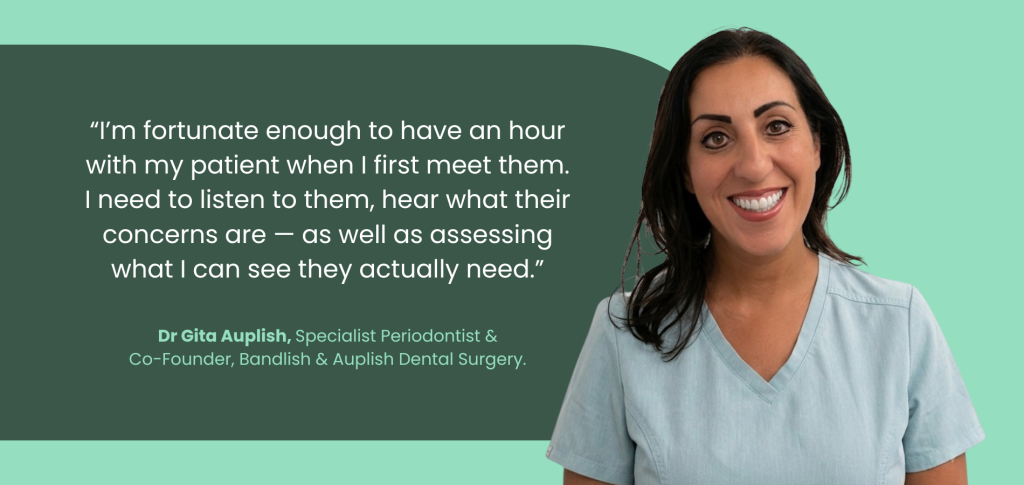
When you come to see me for the first time, I set aside a full hour. That might seem like a long time for a dental appointment. It is not. It is the right amount of time to do the job properly.
We start with a conversation. I want to understand what has brought you in, what you have noticed, what concerns you. I will have already received a referral letter from your dentist, so I have some background — but I want to hear it from you, because what patients say about their own experience tells me a great deal.
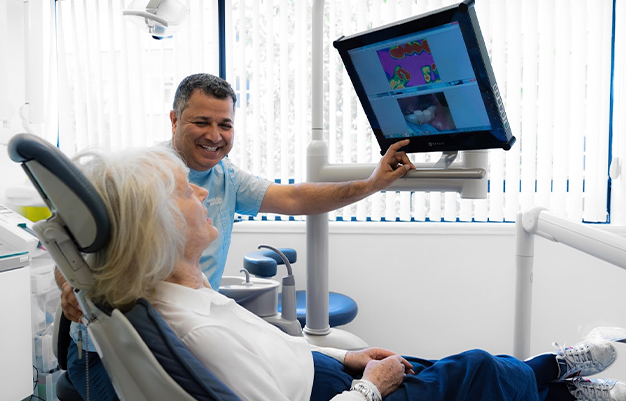
Then we move to the clinical examination. I examine your mouth, teeth, and gums thoroughly, take the necessary X-rays, and measure the depth of the pockets around each tooth. Those measurements — recorded on a chart called a periodontal chart — tell me where the infection is, how deep it goes, and how much bone has been affected. It is from this information that I can give you an accurate diagnosis and a clear picture of what is going on.
By the end of that first appointment, you will understand exactly what stage your gum disease is at, what treatment I am recommending, and what your role will be in making that treatment work. That last part matters enormously — and I will come back to it.
Treatment for gum disease follows a logical sequence. We call it initial therapy, and it happens in stages.
The first step is always improving the baseline. Before we do anything in the dental chair, we work on your daily oral hygiene routine — the way you brush, the way you clean between your teeth, the tools you use. Most people brush twice a day with an electric toothbrush, which is a good start. But technique matters. The angle, the pressure, the surfaces you cover — these things make a real difference, and small adjustments can significantly reduce the inflammation in your gums.
We also talk about lifestyle factors. Smoking is one of the biggest accelerators of gum disease, and if you smoke, stopping is one of the most impactful things you can do for your gum health. Diabetes, as I have written about elsewhere, has a direct relationship with gum disease, and controlling blood sugar is part of the treatment.
Once the foundations are in place, we begin the clinical treatment. This generally involves numbing the gums with local anaesthetic — so you feel nothing — and then thoroughly removing the hardened tartar and bacteria from around and beneath the gum line. This is what is sometimes called deep cleaning, and it is the cornerstone of gum disease treatment.
The gums are then given around eight to ten weeks to heal. After that, I re-measure everything. We compare the pocket depths to what they were at the start, and we assess how well the treatment has worked.
I always tell patients that gum disease treatment is a partnership. I can play my part — and that part is essential — but I genuinely cannot do it alone. The work I do in the chair removes the infection and gives the gum tissue a chance to heal. But whether that tissue stays healthy depends enormously on what you do every day at home.
This is not about blame. It is about being honest with you. Patients who commit to the daily routine — brushing properly, cleaning between their teeth, coming to their maintenance appointments — can keep their gum disease stable for decades. I have patients who came to me with quite advanced disease twenty or more years ago, who still have all their teeth today. That is genuinely possible.
What I ask of you is that you take the information I give you and use it. The tools are not complicated. The technique can be learned. The consistency is down to you.
The patients I am perhaps most proud of are not the ones who came in early with mild gingivitis and were straightforward to treat. They are the ones who came in full of fear and shame — who had been putting off coming for years, or even decades — and who eventually decided to walk through the door.
Shame has no place in a dental environment. If you are sitting here reading this and thinking, it has been a long time and I am embarrassed about it — please let that go. The only wrong decision is not coming at all.
Whatever state your gum health is in when you arrive, I will meet you there. We will work out what needs to be done, we will do it together, and we will move forward. That is what this is for.
Dr Gita Auplish is a specialist periodontist and co-founder of Bandlish & Auplish Dental Surgery. She holds a Master’s degree in Periodontology and her Fellowship of the Royal College of Surgeons, and works as a Consultant at King’s College Hospital, London, where she trains the next generation of specialist periodontists.






Fill in the form and our friendly team will be in touch with you monumentarily
The practice is incredibly client focused from the moment you pick up the phone to the aftercare provided. Gita was fantastic and clear in explaining then resolving the issues I had. The results at th... Read More
I came to Dr. Gita Auplish after being turned away by an Invisalign provider who found gum disease during a routine clean and told me I’d need to see a specialist, then put me on a waiting list with... Read More
Like many people, I’ve had a longtime fear of the dentist but I’m very happy to leave a review here to let other people know you couldn’t be in better hands than with Gita. I was referred by my ... Read More
After a previous horrific incident at former dentist, I was extremely hesitant to attend another, I eventually found bandlish & auplish and now needed peridontal care it having been that long, I was b... Read More
I made an appointment with Doctor Auplish after finding out I’d experienced bone loss due to gum disease. From the moment I met Gita she made me feel like we would solve everything together, and I n... Read More