- Our Most Popular Treatments
- Our Testimonials
- Start Your Smile Journey
By Dr Gita Auplish, Specialist Periodontist & Co-Founder, Bandlish & Auplish Dental Surgery
“Gum graft” is not a phrase that puts anyone at ease. It sounds major. It sounds like something that will hurt, take weeks to recover from, and cost a fortune.
In practice it is one of the more straightforward procedures I do, and the recovery surprises most of my patients by how quick it is. But because so few people have heard of it before they are told they might need one, it comes loaded with assumptions. Let me take the three questions I am asked most and answer them properly.
A gum graft, also called a soft-tissue or gingival graft, replaces gum tissue that has been lost through recession and covers over the exposed tooth root.
Gum tissue does not grow back on its own. Once the gum has receded, the root stays exposed, and that exposed root is what causes the sharp sensitivity to cold and sweet things, raises the risk of decay at the neck of the tooth, and produces the “long in the tooth” look people dislike in photographs.
A graft solves all three at once. It puts tissue back where tissue used to be.
There are a few different techniques. A connective tissue graft, the most common, takes a small amount of tissue from the roof of the mouth and tucks it under the gum to cover the root. A free gingival graft thickens gum tissue that is too thin to survive. A pedicle graft moves neighbouring gum sideways over the exposed root. Which one is right for you depends on how much recession there is, how thick your existing gum is, and how many teeth are involved.
This is the part patients most want to know, and the honest answer is: less than you are imagining.
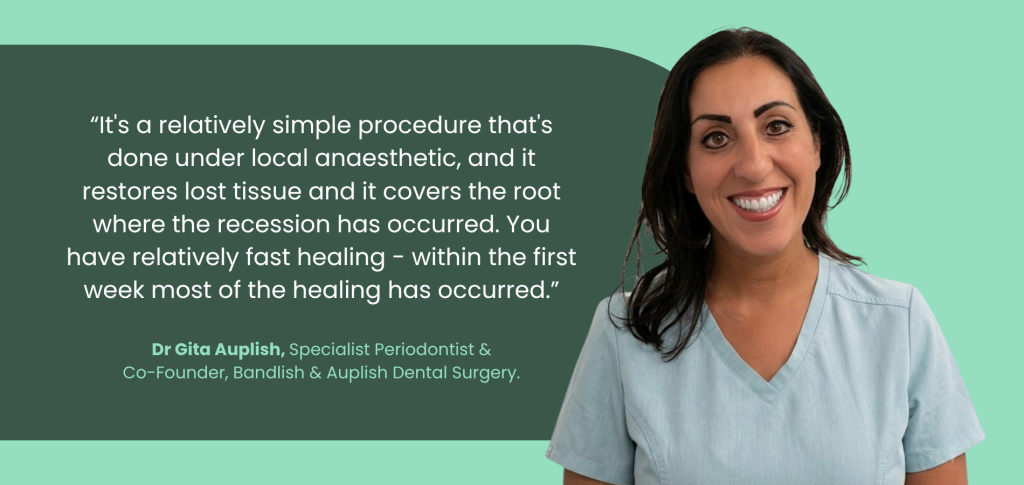
You are awake, but the area is completely numb. You will feel pressure and movement, which is normal, but not pain. The procedure itself typically takes between 45 minutes and 90 minutes depending on how many teeth are being treated. You go home the same day.
Afterwards, you will have some swelling and tenderness, most of it concentrated in the first two or three days. Over-the-counter painkillers handle it for the great majority of patients. You will be on soft foods for a few days and asked not to brush the graft site directly while it settles, using a prescribed rinse instead.
Most of the healing happens inside that first week. The tissue continues to mature and blend in over the following couple of months, which is why the final cosmetic result is better at three months than it is at three weeks.
Most people take one or two days off work, and many take none at all.
This is the question I get asked more than any other, usually by someone who has been putting off doing anything about their recession for years and is quietly worried they have left it too long.
The answer is that it is rarely too late to be assessed, but there is a point at which grafting stops being the right answer.
Here is why. A gum graft replaces soft tissue. It does not replace bone. If the recession is purely a soft-tissue problem and the bone underneath is intact, a graft has an excellent chance of covering the root and staying put. But if the recession has come alongside significant bone loss, and particularly if the tooth has started to move or feel loose, there is nothing solid for the grafted tissue to sit against. The graft will not hold, and the sensible conversation becomes about stabilising the tooth rather than covering it.
Active gum disease is a different matter. That is not “too late”, it is simply “not yet”. We stabilise the disease first, then reassess for grafting once the gums are healthy. Grafting over active infection would waste the graft.
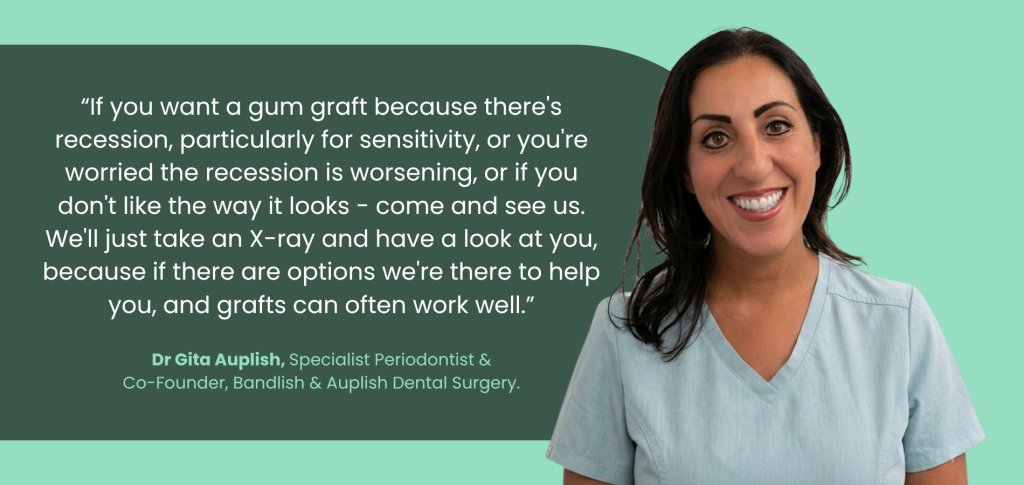
The practical point is this: you cannot tell which situation you are in by looking in the mirror. It takes an X-ray and a periodontal assessment.
I understand why people want a number before they walk through the door, and I am afraid I cannot give a meaningful one on a web page. Here is why, and what you can rely on instead.
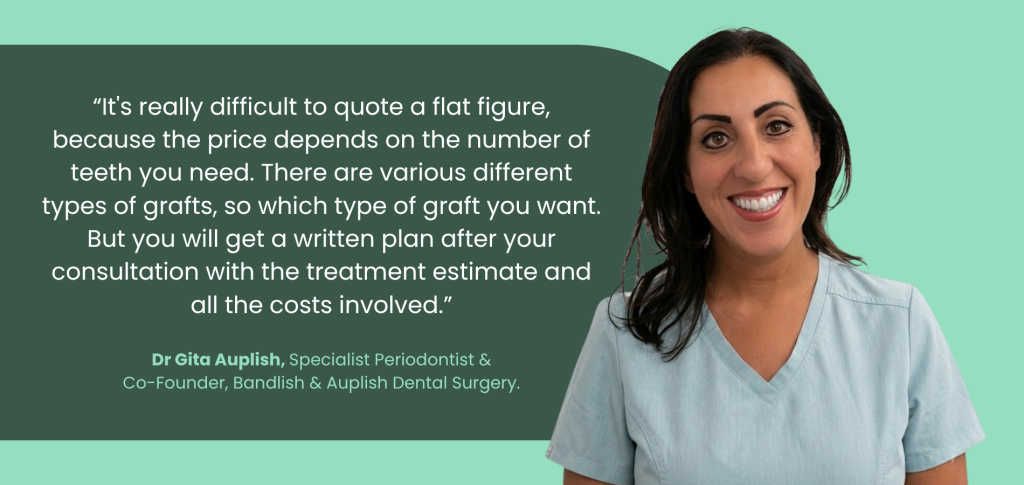
The two variables that move the price most are how many teeth need treating and which technique is used. Grafting a single lower incisor is a different undertaking from restoring recession across six teeth in the upper arch. A pedicle graft using adjacent tissue costs differently from a connective tissue graft taken from the palate.
What I can promise is that you will never be asked to commit to anything without a written figure in front of you. After your consultation and assessment you receive a written treatment plan setting out exactly what is proposed and what it costs, in full, before anything begins.
We also offer 0% interest-free finance, which lets you spread the cost over a fixed term rather than paying up front. Full fees are on our Fees and Finance page.
For the right patient, yes, and the reasons are usually a mix of the practical and the personal.
Practically, covering an exposed root removes the sensitivity, protects a vulnerable surface from decay, and stops progressive recession that would otherwise threaten the tooth. Cosmetically, it evens up a gum line that has been bothering someone for years, often more than they let on.
The patients who get the best results are the ones who come in while the recession is moderate and the bone underneath is still healthy. That is the argument for getting assessed sooner rather than later, and it is really the only argument I need to make.
Not during the procedure. It is carried out under local anaesthetic, so the area is completely numb and you will feel pressure but not pain. Afterwards there is some tenderness and swelling for two to three days, which most patients manage with over-the-counter painkillers.
Most of the healing happens within the first week. You will be on soft foods and using a prescribed rinse rather than brushing the site for several days. The tissue continues to mature and blend over the following two to three months, which is when you see the final result.
Grafting is generally not appropriate once significant bone has been lost around the tooth, particularly if the tooth has become loose, because there is nothing stable for the grafted tissue to attach to. Active gum disease is not too late, but must be stabilised before grafting. Only an X-ray and periodontal assessment can tell you which applies.
It depends on the number of teeth being treated and the grafting technique used, so a flat figure is not meaningful. You receive a written treatment plan with the full cost after your consultation, before any treatment begins. 0% interest-free finance is available.
No. Gum tissue does not regenerate on its own. Treating the underlying cause will stop recession progressing, but replacing lost tissue requires a graft.
Yes, but the gum disease is treated and stabilised first. Grafting over active infection would compromise the result.
No. You can self-refer to a specialist periodontist. We also receive referrals from general dentists across London for complex recession cases.
Most patients take one or two days, and many take none. You should avoid strenuous exercise for a few days and stick to soft foods while the graft settles.
Dr Gita Auplish is a specialist periodontist (GDC 71011) and co-founder of Bandlish & Auplish Dental Surgery on Harley Street. She holds a Master’s degree in Periodontology and her Fellowship of the Royal College of Surgeons, and works as a Consultant at King’s College Hospital, London, where she trains the next generation of specialist periodontists.
Considering a gum graft? Book a consultation with Dr Gita at Bandlish & Auplish or call 020 7436 9804.






Fill in the form and our friendly team will be in touch with you monumentarily
The practice is incredibly client focused from the moment you pick up the phone to the aftercare provided. Gita was fantastic and clear in explaining then resolving the issues I had. The results at th... Read More
Like many people, I’ve had a longtime fear of the dentist but I’m very happy to leave a review here to let other people know you couldn’t be in better hands than with Gita. I was referred by my ... Read More
After a previous horrific incident at former dentist, I was extremely hesitant to attend another, I eventually found bandlish & auplish and now needed peridontal care it having been that long, I was b... Read More
Simply the best... worth every penny, for expertise and care like no other! Bobby is the OG GOAT dentist - just amazing - and Rosie is a fantastic hygienist. Takes all the fear and anxiety out of... Read More
From the very first appointment, Gita made me feel heard and reassured. She took my concerns seriously, explained everything clearly, and came up with a plan that truly worked! Since her care, my gums... Read More