- Our Most Popular Treatments
- Our Testimonials
- Start Your Smile Journey

By Dr Gita Auplish, Specialist Periodontist & Co-Founder, Bandlish & Auplish Dental Surgery
People are often surprised to learn that periodontists place implants. They assume gum specialists deal with gums and someone else deals with the replacing of teeth.
In fact the two belong together, and once you understand why, the logic of it is obvious. An implant is anchored in bone and surrounded by gum. The person who spends their career keeping bone and gum healthy is exactly the person who should be putting something into it.
An implant is not a false tooth that clips on to something. It replaces the root as well as the crown.
That last point is the one I would underline. The traditional alternative for a single missing tooth is a bridge, which works by cutting down the healthy teeth on either side of the gap and using them as supports. It is a perfectly good treatment and sometimes the right one. But it involves damaging two sound teeth in order to replace one missing one.
An implant does not touch its neighbours. A titanium post is placed into the jawbone, the bone integrates with it over a period of months, and a crown is then fitted on top. Once it has healed, it functions and feels much like the tooth it replaced. You brush it, you floss around it, you eat normally.
The crown itself is made to match:
Here is the part that gets skipped in a lot of implant marketing, and it is the reason I am writing this post.
Note the phrase: the whole mouth, not just the gap.
Implants can develop their own version of gum disease. It is called peri-implantitis, and it works in much the same way. Bacteria collect around the implant, the tissue becomes inflamed, and the bone supporting the implant is lost. If enough bone goes, the implant fails and has to be removed.
The single biggest predictor of peri-implantitis is a history of untreated or unstable periodontal disease elsewhere in the mouth. The bacteria do not stay politely in one place. Placing an implant into a mouth with active gum disease is putting a new post into an infected environment and hoping for the best.
This is why, when someone comes to me wanting an implant, the conversation almost never starts with the implant. It starts with a full periodontal assessment of every tooth, X-rays, and pocket measurements. If there is active disease, we treat and stabilise it first. If there is not, we can move forward.
It sometimes feels to patients like a delay. It is not. It is what makes the implant last.
If you have gum disease and you want an implant, the pathway usually runs like this:
Losing time at step two is not losing time. Patients who skip it are the ones who end up back in a chair years later having the implant removed.
You can be referred by your dentist, or you can come directly.
On the question of why it matters who does the work, I have an analogy I use with patients most weeks:
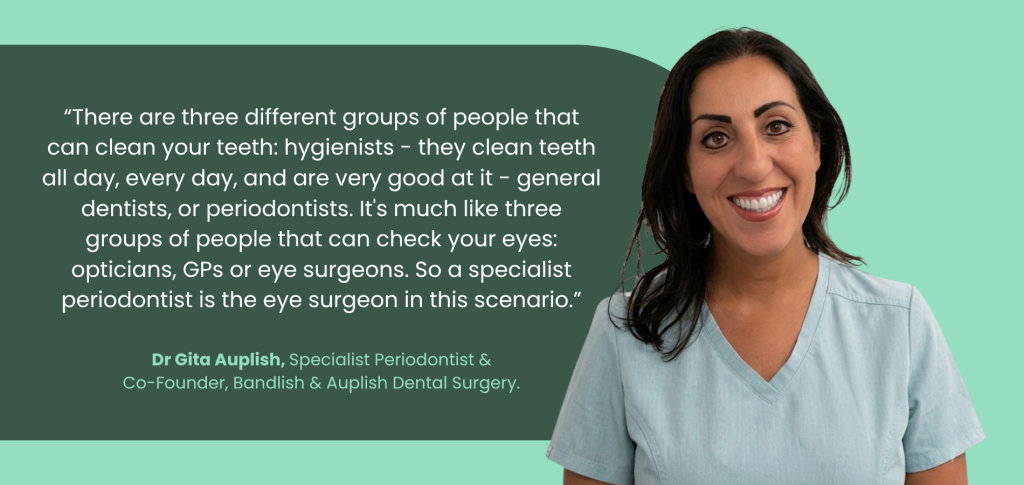
That is not a criticism of general dentists, who are exceptionally skilled across an enormous range of work. It is a point about depth in one narrow area. A specialist periodontist is on the GDC specialist register, which requires years of additional postgraduate training in gum disease, bone, soft tissue and implants specifically.
For a straightforward single implant in a healthy mouth, plenty of general dentists do excellent work. Where specialist involvement genuinely changes the outcome is where there is a history of gum disease, where bone is limited, where previous treatment has failed, or where the site is in the visible part of the smile and the gum contour around the crown has to look right.
For most people who have lost a tooth and have healthy foundations, yes.
They do not damage neighbouring teeth. They preserve the bone in the jaw, which continues to shrink where a tooth is missing and nothing replaces the root. They do not come out at night. And they are the closest thing dentistry has to giving someone their own tooth back.
They are also a significant investment, and the honest position is that they are not right for everyone or for every site. Costs depend on whether bone grafting is needed, how many teeth are involved, and the complexity of the case, so you will get a written plan with the full figure after your assessment, before anything begins. Interest-free finance is available to spread the cost.
The one thing I would say to anyone considering an implant: ask whoever is treating you how they have assessed the health of your gums across the whole mouth, not just at the gap. If that conversation has not happened, it needs to.
Yes. An implant replaces both the root and the crown of the tooth, making it the closest available equivalent to a natural tooth. Unlike a bridge, it is standalone and does not involve cutting down or damaging the teeth on either side of the gap.
Not while the gum disease is active. Any periodontal disease must be treated and stabilised across the whole mouth first, because implants can develop their own form of gum disease, called peri-implantitis, which causes them to fail. Once the gums are stable, implants are usually possible.
It is inflammation and bone loss around a dental implant, caused by bacteria in much the same way as gum disease around a natural tooth. Untreated, it leads to implant failure. A history of untreated periodontal disease is the biggest risk factor.
Yes. The crown is customised for colour, shape and size to match the surrounding teeth. Where an implant is in the visible part of the smile, the contour of the gum around it matters as much as the crown itself, which is one reason specialist involvement helps.
No. You can self-refer for advanced gum problems and for implants. We also accept referrals from general dentists across London.
It depends on the number of implants, whether bone grafting is needed, and the complexity of the case. You receive a written treatment plan with the full cost after your assessment, before treatment begins. Interest-free finance is available.
Once the gums are stable, the bone typically needs three to six months to integrate with the implant before the final crown is fitted. Where periodontal treatment or bone grafting is needed first, the overall timeline is longer.
Dr Gita Auplish is a specialist periodontist (GDC 71011) and co-founder of Bandlish & Auplish Dental Surgery on Harley Street. She holds a Master’s degree in Periodontology and her Fellowship of the Royal College of Surgeons, and works as a Consultant at King’s College Hospital, London, where she trains the next generation of specialist periodontists.
Considering an implant? Book a consultation with Dr Gita at Bandlish & Auplish or call 020 7436 9804.






Fill in the form and our friendly team will be in touch with you monumentarily
The practice is incredibly client focused from the moment you pick up the phone to the aftercare provided. Gita was fantastic and clear in explaining then resolving the issues I had. The results at th... Read More
Like many people, I’ve had a longtime fear of the dentist but I’m very happy to leave a review here to let other people know you couldn’t be in better hands than with Gita. I was referred by my ... Read More
After a previous horrific incident at former dentist, I was extremely hesitant to attend another, I eventually found bandlish & auplish and now needed peridontal care it having been that long, I was b... Read More
Simply the best... worth every penny, for expertise and care like no other! Bobby is the OG GOAT dentist - just amazing - and Rosie is a fantastic hygienist. Takes all the fear and anxiety out of... Read More
From the very first appointment, Gita made me feel heard and reassured. She took my concerns seriously, explained everything clearly, and came up with a plan that truly worked! Since her care, my gums... Read More