- Our Most Popular Treatments
- Our Testimonials
- Start Your Smile Journey
By Dr Gita Auplish, Specialist Periodontist & Co-Founder, Bandlish & Auplish Dental Surgery
Every so often a patient asks me a question with a slightly embarrassed laugh, as though it might be a silly one. “Can my husband catch this from me?” is one of those.
It is not a silly question at all. It is a good one, the answer is more interesting than a simple yes or no, and it leads directly into something far more useful: how to tell whether your own gums are healthy without waiting six months to be told.
The bacteria are transmissible. The disease is not, at least not in the way we usually mean the word.
Here is what that means in practice. The bacteria that drive periodontal diseaselive in plaque and in saliva, and saliva moves between people. Kissing, sharing a toothbrush, sharing cutlery, a parent tasting a child’s food from the same spoon. So yes, the organisms can be passed on.
But being exposed to the bacteria is not the same as developing the disease. Whether those bacteria cause damage in your mouth depends on three things that have nothing to do with your partner:
Your immune response. Gum disease is largely a story about how your body reacts to bacteria, not just about the bacteria being there. Two people can carry the same organisms and only one of them loses bone. Susceptibility runs in families genetically, which is one reason gum disease sometimes looks contagious when it is actually inherited.
Your cleaning. How thoroughly and how consistently you disrupt plaque every day is the single biggest thing within your control.
Your risk factors. Smoking is the most significant accelerator there is. Uncontrolled diabetes is close behind. Stress, certain medications, and hormonal changes all play a part.
So the honest answer to “can I catch it?” is: you can be exposed to the bacteria, but you develop gum disease because of how your body and your routine handle them.
Nobody needs to stop kissing their partner. That is not the takeaway, and I would not want anyone leaving this page anxious about their family life.
What is genuinely worth doing:
Do not share toothbrushes. Ever, with anyone. This one is straightforward.
If one of you has been diagnosed with periodontitis, the other should get assessed. Not because they have “caught” it, but because shared bacteria, shared habits, and often shared genetics mean the risk is higher than average. It is a sensible screening, not a cause for alarm.
Treat it as a household project. Households where everyone cleans well have less bacteria circulating in general. Getting the interdental brushes into the bathroom for two people rather than one makes a measurable difference.
Be a little careful with young children. Blowing on food, tasting from the same spoon, and cleaning a dropped dummy in your own mouth all transfer bacteria to a child whose oral flora is still establishing.
This is the part I would most like you to take away. You do not have to wait for a dental appointment to know whether something is wrong. Gum disease is largely silent in its early and middle stages, which is exactly why knowing what to look for matters so much.
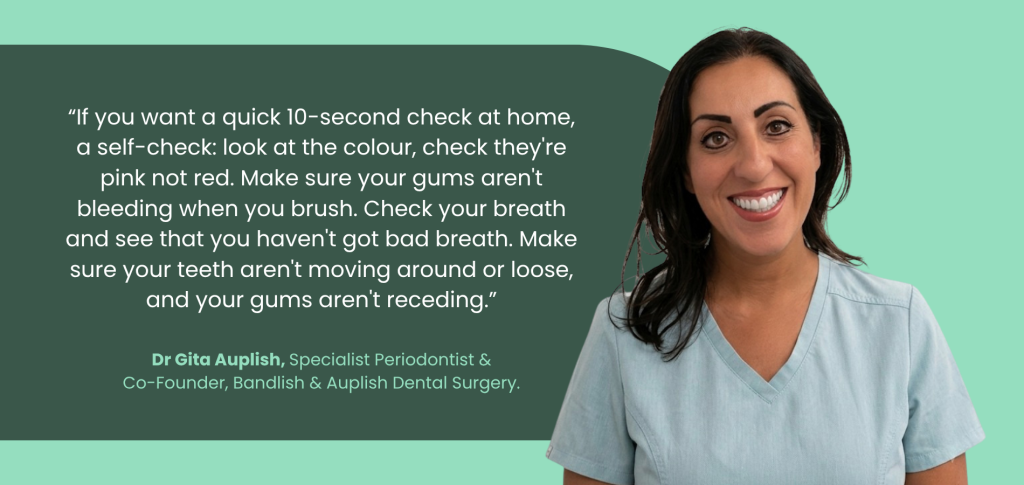
Five things, in front of the bathroom mirror, tonight.
1. Colour. Healthy gums are pale pink, firm and tight against the teeth. Red, dark, shiny or puffy gums are inflamed. Look particularly at the little triangles of gum between the teeth, which is where inflammation shows first.
2. Bleeding.Bleeding when you brush or clean between your teeth is not normal, and it is not a sign you are brushing too hard. It is the single most reliable early warning sign there is. Healthy gums do not bleed.
3. Breath. Persistent bad breath that does not shift with brushing and mouthwash often comes from bacteria sitting in deep pockets around the teeth, where a toothbrush cannot reach.
4. Movement. Are any teeth loose? Have any of them shifted position, or have gaps opened up between teeth that used to sit together? Movement is a later sign, and it means the supporting bone has been affected.
5. Recession. Do your teeth look longer than they did in photographs from a few years ago? Can you feel a step or notch where the enamel ends at the gum line?
If any of those five apply, book an appointment. If two or more apply, do not wait for your next routine check-up.
The self-check is a screening tool, not a diagnosis. It tells you whether to be concerned, not how bad things are.
That is because the measurement that actually matters, the depth of the pocket around each tooth and how much bone is supporting it, cannot be seen from the outside. A mouth can look reasonably healthy and still be losing bone.
Less worried than you might think, provided you act.
Gingivitis, where the gums are inflamed but the bone is untouched, resolves completely with a professional clean and better daily cleaning. No lasting damage.
Periodontitis, where bone has been lost, cannot be reversed, because bone does not grow back. But it can be stabilised, much as diabetes is stabilised, and stabilised gum disease does not have to cost you teeth. I have patients who arrived with advanced disease more than 25 years ago who still have all their teeth today.
The difference between those two outcomes is almost always how quickly someone acted after they first noticed something.
It is worth saying that this is not only about teeth.
Ten seconds in front of the mirror is a small thing. It is also, for a lot of people, the moment they finally do something about a problem they had been half-noticing for years.
The bacteria that cause gum disease can pass between people through saliva, so kissing or sharing a toothbrush can transfer them. However, whether you develop gum disease depends on your own immune response, your cleaning routine and your risk factors, not simply on exposure to the bacteria.
You can be exposed to the bacteria this way, but that alone does not give you gum disease. Good daily cleaning protects both people. If your partner has been diagnosed with periodontitis, it is sensible to have your own gums assessed.
Check five things: gums pink rather than red, no bleeding when you brush, no persistent bad breath, no loose or shifting teeth, and no recession. If any of these are a problem, book an assessment. Only an examination with X-rays can measure what is happening below the gum line.
Early on, bleeding when brushing, with gums that may look slightly red or swollen. Later, gums appear red, puffy and receded, teeth look longer, gaps open up, and teeth may loosen. Healthy gums are pink, firm and tight.
Gingivitis, the early stage, is completely reversible with professional cleaning and improved daily hygiene. Periodontitis, where bone has been lost, cannot be reversed but can be stabilised and kept under control long term.
It is a sensible precaution. Shared bacteria, shared habits and shared genetics mean the risk is higher than average, though it is a screening rather than a cause for alarm.
Gum disease is associated with general inflammation in the body and has well-documented links with diabetes and cardiovascular health. This is one of the reasons it is worth treating early rather than living with it.
Dr Gita Auplish is a specialist periodontist (GDC 71011) and co-founder of Bandlish & Auplish Dental Surgery on Harley Street. She holds a Master’s degree in Periodontology and her Fellowship of the Royal College of Surgeons, and works as a Consultant at King’s College Hospital, London, where she trains the next generation of specialist periodontists.
Concerned about something you found? Book a gum health assessment with Dr Gita at Bandlish & Auplish or call 020 7436 9804.






Fill in the form and our friendly team will be in touch with you monumentarily
The practice is incredibly client focused from the moment you pick up the phone to the aftercare provided. Gita was fantastic and clear in explaining then resolving the issues I had. The results at th... Read More
I came to Dr. Gita Auplish after being turned away by an Invisalign provider who found gum disease during a routine clean and told me I’d need to see a specialist, then put me on a waiting list with... Read More
Like many people, I’ve had a longtime fear of the dentist but I’m very happy to leave a review here to let other people know you couldn’t be in better hands than with Gita. I was referred by my ... Read More
After a previous horrific incident at former dentist, I was extremely hesitant to attend another, I eventually found bandlish & auplish and now needed peridontal care it having been that long, I was b... Read More
I made an appointment with Doctor Auplish after finding out I’d experienced bone loss due to gum disease. From the moment I met Gita she made me feel like we would solve everything together, and I n... Read More