- Our Most Popular Treatments
- Our Testimonials
- Start Your Smile Journey
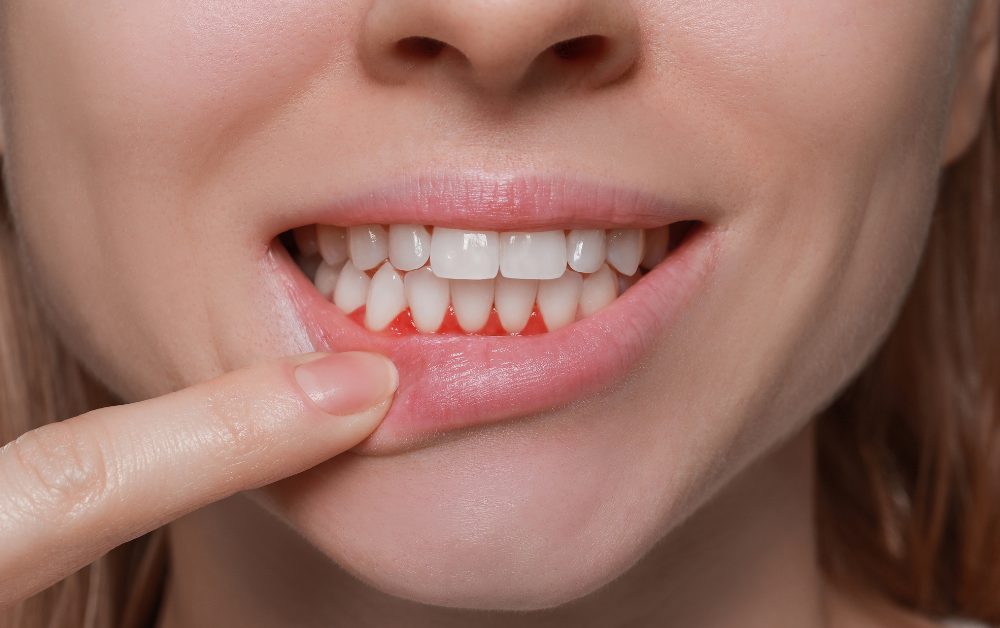
One of the most common things I hear from patients when they first come to see me is some version of: “My gums bleed when I brush, but I thought that was just normal.” It isn’t. Healthy gums do not bleed. If yours do, it is a sign of infection — and it is something that needs to be addressed, not ignored.
I have been a specialist periodontist for over two decades, and if there is one myth I could bust for every person in the UK, it would be this one. Bleeding gums are not normal. They are your mouth’s way of telling you that something is wrong.
Not sure what your bleeding gums mean? Our guide to the stages of gum disease explains what each stage looks like and how it’s treated.
When your gums bleed — whether when you brush, floss, or eat something hard — it is a sign of inflammation caused by bacteria. That bacteria lives in plaque, the sticky film that builds up on your teeth every single day. If plaque is not removed properly, it triggers an immune response in the gum tissue, and that is what causes the bleeding.
The good news is that at this stage, the problem is often very manageable. The earlier you catch it, the simpler the treatment.
Gingivitis is the earliest form of gum disease. Your gums bleed, they may look slightly red or swollen, and you might notice them feeling a little tender. At this stage, the infection has not yet gone deep — the underlying bone and connective tissue that hold your teeth in place are unaffected.
This is important, because gingivitis is completely reversible. With a professional clean and improvements to your daily oral hygiene routine, your gums can return to full health. No lasting damage done.
When gingivitis is left untreated, the plaque hardens into what we call tartar or calculus. Think of it like limescale forming inside a kettle — except this is stuck to your teeth and roots, underneath the gum line, and no amount of brushing will shift it. It has to be removed professionally.
As the tartar builds up beneath the gums, the bacteria it harbours begins to eat away at the bone that supports your teeth. This is periodontitis — and unlike gingivitis, it is irreversible. Once bone is lost, it does not grow back.
This does not mean all hope is gone. Far from it. But it does mean that the aim of treatment shifts from reversal to stabilisation: removing the infection, stopping further bone loss, and keeping your teeth for as long as possible.
If periodontitis continues without treatment, patients start to notice symptoms beyond bleeding. Teeth may shift position or feel loose. You might develop gum abscesses, notice spaces opening up between teeth, or find that your bite feels different. By this stage, some teeth may be beyond saving.
The difficult thing about gum disease is that it is largely silent in its early and middle stages. It is not very painful. People often have no idea how far things have progressed until something more dramatic happens. This is why regular dental check-ups — and acting on early signs like bleeding — matter so much.
Many patients reach for a mouthwash when they notice their gums are bleeding, assuming an antibacterial rinse will sort the problem out. I understand the logic, but it almost never works. A mouthwash can mask symptoms temporarily, but it cannot remove the plaque and tartar that are causing the infection.
If your gums are bleeding, you need to see a dental professional — whether that is your dentist, a hygienist, or a specialist periodontist, depending on how far things have progressed. The sooner you go, the simpler the solution.
First, do not stop brushing. I know it feels counterintuitive when your gums are sore and bleeding, but brushing less makes things worse, not better. Brush twice a day with an electric toothbrush, and pay attention to your technique — the angle matters, and most people are not using their brush as effectively as they could be.
Second, clean between your teeth. A toothbrush only reaches about 60% of your tooth surfaces. The remaining 40% — the spaces in between — can only be reached with interdental brushes. Floss has its place, but interdental brushes are far more effective for most people. They come in different sizes, and you may need more than one to fit all the gaps between your teeth.
Third, if you have noticed bleeding that does not settle down within a week or two of improving your cleaning, book an appointment. Do not wait and see.
I see a lot of patients who feel embarrassed about coming in. They have been ignoring the bleeding for months or years, and they are worried about being told off. That is not how I work, and it is not the environment we create at Bandlish & Auplish.
Whatever stage you are at, coming in is always the right decision. My job is to help you move forward — not to make you feel worse about where you are now.
Dr Gita Auplish is a specialist periodontist and co-founder of Bandlish & Auplish Dental Surgery. She holds a Master’s degree in Periodontology and her Fellowship of the Royal College of Surgeons, and works as a Consultant at King’s College Hospital, London, where she trains the next generation of specialist periodontists.






Fill in the form and our friendly team will be in touch with you monumentarily
The practice is incredibly client focused from the moment you pick up the phone to the aftercare provided. Gita was fantastic and clear in explaining then resolving the issues I had. The results at th... Read More
I came to Dr. Gita Auplish after being turned away by an Invisalign provider who found gum disease during a routine clean and told me I’d need to see a specialist, then put me on a waiting list with... Read More
Like many people, I’ve had a longtime fear of the dentist but I’m very happy to leave a review here to let other people know you couldn’t be in better hands than with Gita. I was referred by my ... Read More
After a previous horrific incident at former dentist, I was extremely hesitant to attend another, I eventually found bandlish & auplish and now needed peridontal care it having been that long, I was b... Read More
I made an appointment with Doctor Auplish after finding out I’d experienced bone loss due to gum disease. From the moment I met Gita she made me feel like we would solve everything together, and I n... Read More